He Hanganga Tūpuna - Ancestral Architecture
TAITOKERAU TRIBAL INFRASTRUCTURE
If there was ever an infrastructure for Taitokerau, Ngāpuhi or Hokianga to understand, this is it.
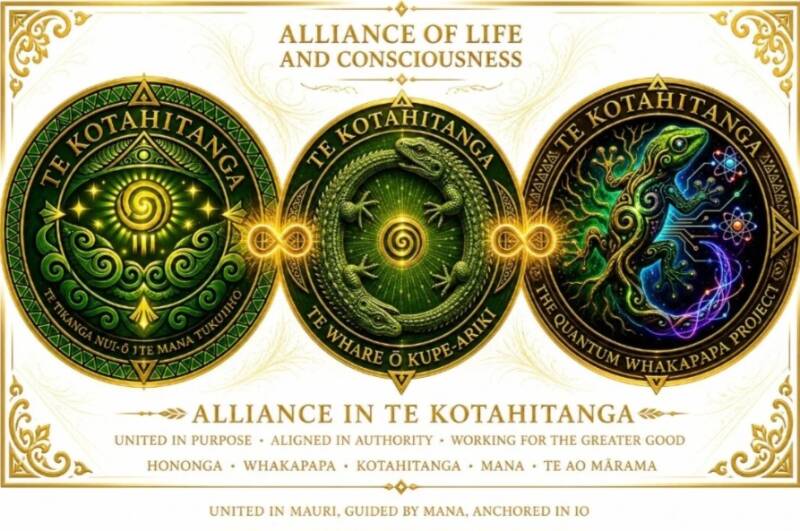
TE WHARE Ō KUPE-ARIKI — IO TO 1835
Te Whare Ō Kupe-Ariki is the overarching Whare Ariki structure from IO to 1835. Within this Whare are the descended Whare Ariki lines of Kupe. These are not separate Whare Ariki placed alongside Kupe or outside the Whare. They are descendant lines of Kupe and therefore sit within the wider Whare Ariki structure. Each carries its own whakapapa, tūpuna, mana, tikanga and inherited responsibilities. This ancestral sequence extends from IO, through Ngā Rangitūhaha, Hawaiki, Ra'iatea, Te Moana Nui ā Hīva, Maupiti, Rarotonga and Aotearoa, to Hokianga.
TE WHARE Ō KUPE-ARIKI — THE ROYAL HOUSE OF KUPE
The video Tau Rangatira 2024 is more important than anyone could realise. It records the reinstallation of IO and Te Whare Ariki within the ancestral infrastructure of Taitokerau, Ngāpuhi and Hokianga at Tau Rangatira, Waitangi.
REALIGNING TAITOKERAU · NGĀPUHI · HOKIANGA WITH ITS TRUE ANCESTRAL INFRASTRUCTURE
On 2 and 6 February 2024, at Tau Rangatira, we undertook the applied tikanga to reinstall IO and Te Whare Ariki within the Ngāpuhi Architecture. To understand the significance of what took place, we must first understand the origins of our Whare Ariki, from IO through tūpuna Kupe and Nuku, through to Rāhiri and 1835. These are the ancestral foundations of our Arikitanga. It was also the period when we set aside the Ui Arii, Ui Raatira and Arikitanga, and the land wars began. For the last 186 years, we have been in restoration mode because He Wakapūtanga Ō Te Rangatiratanga Ō Nū Tīreni was not honoured. Our attention has largely been directed towards land claims, protesting for sovereignty, fighting poverty, and restoring Ngāpuhi tikanga and reo. If you are from Taitokerau, Ngāpuhi or Hokianga, our Arikitanga comes from IO and Kupe. This video shows 20 Ariki reconnecting what had been separated for 186 years since 1835. While everyone was opening the new Whare Te Tiriti Ō Waitangi, this is what we were doing: reinstating Te Whare Ō Kupe-Ariki. Fully transparent, in plain sight for all to see.
ANCESTRAL INFRASTRUCTURE — TAITOKERAU · NGĀPUHI · HOKIANGA
Tino IO Arikitanga, Tino Tohungatanga and Tino Rangatiratanga go hand in hand. This relationship is at the heart of the restoration. To understand Tino Rangatiratanga within our ancestral infrastructure, we must also understand Tino IO Arikitanga and the origins of our Whare Ariki. Let us not mistake this for an Upper House narrative. That narrative does not belong within the He Wakapūtanga 1835 narrative. That is a Ngā Iwi Ō Runga narrative through Kōhuiarau, not He Wakapūtanga. We understand Te Kauae Runga and Te Kauae Raro. However, this is also not a Ngāpuhi narrative of ancient kōrero. That belongs to Ngāti Kahungunu Tohunga Scholars. Our understanding of the same knowledge is Te Kauwae Tohora and Te Putea Whakairo, as illustrated through Ngākuru Pene Haare Te Wao's moemoeā.
THE REINSTALLATION OF IO AND TE WHARE ARIKI IN THE NGĀPUHI NARRATIVE
To understand an Upper and Lower House from a Ngāpuhi perspective, we must first understand our own architecture and its order:
• Te Whare Atua
• Te Whare Ariki
• Te Whare Kokorangi
• Te Whare Wānanga
• Te Whare Whakairo
• Te Whare Moko
• Te Whare Tū Taua
• Te Whare ā Te Rēhia
• Te Whare Pōrā
• Te Whare Kōhanga
These ten Whare establish the cultural architecture through which we must understand our ancestral infrastructure. They hold the cultural practices associated with Te Whare Ō Kupe-Ariki and provide the foundation for understanding our origins, Atuatanga, Arikitanga and collective responsibilities.
THE APPLIED TIKANGA AT TAU RANGATIRA
The applied practice shown in this video represents the reinstallation of IO, Te Whare Atua and Te Whare Ariki into the Ngāpuhi Architecture from Tau Rangatira. The tikanga took place on two occasions, 2 and 6 February 2024, from 2 am to 6 am each time. The gathering included:
• More than 20 Whare Ariki represented.
• The punga, or anchor stone, of the Maatatua Waka.
• Te Kāpura, the sacred fires of IO, lit throughout each applied practice.
• Our Tohunga Whakapapa reciting 800 generations of Tātai Arorangi: from IO to Kupe, Kupe to Rāhiri, and Rāhiri to Ngāpuhi.
The reinstallation was undertaken because, as Ngāpuhi, we come from Ariki lines, but we have decided not to talk about it. The video therefore captures more than a gathering or the performance of tikanga. It records the applied practice through which we sought to reconnect our ancestral foundations with the present-day Ngāpuhi Architecture.
WHAT THE REINSTALLATION MEANS IN PRACTICE FOLLOWING FEBRUARY 2024
The practitioners who believe in IO continue to practise. This has not stopped. People are welcome to apply to become part of it if they wish.
WHERE NGĀPUHI IS AT PRESENT
Through this restoration, I have identified the source of our Arikitanga coming through tūpuna Kupe-Ariki. In Ngāpuhi, there is no tūpuna above him. Right up until the events captured in this video on 2 Pēpūere 2024, we had not known about Te Whare Atua or Te Whare Ō Kupe-Ariki at all, nor had we attempted to reinstall them. Our attention had been elsewhere, focused on land claims, sovereignty, poverty, tikanga and reo. These matters remain part of the contemporary Ngāpuhi landscape. However, the restoration raises another fundamental question: how can we understand our present circumstances if we do not understand the ancestral infrastructure from which our Atuatanga and Arikitanga come?
The reinstallation brings the relationship between our ancestral origins, the ten Whare, Rangatiratanga and the structures through which Ngāpuhi currently identifies and represents itself to the forefront. This is why the video matters. It brings the ancestral foundation into the discussion of where Ngāpuhi sees itself today.
WHAT IS THE CURRENT STATE OF TE WHARE TAPU Ō NGĀPUHI?
There is not one true, agreed-upon understanding of what Te Whare Tapu is or what it means. Firstly, Te Whare Tapu is not a Whare Ariki. Its function was to unify the hapū of Ngāpuhi when they went outside Te Whare Tapu, identifying them as one force. Its primary function was Matua Tū Taua. This distinction is fundamental. Te Whare Ō Kupe-Ariki and Te Whare Tapu Ō Ngāpuhi are not interchangeable structures. Te Whare Atua and Te Whare Ariki come through the ancestral line of IO, Kupe and Nuku, through to Rāhiri and 1835. Te Whare Tapu Ō Ngāpuhi carries the responsibility of unifying the hapū as one military force when they move beyond the House. Secondly, Ngāpuhi has been overrun by outside religions and churches that are now dictating and controlling Ngāpuhi's true destination. In the time of tūpuna Kupe, the Atua was IO. For those of us who restored Te Whatupungapunga Whare Wānanga, IO remains the Supreme Atua. Our true Atuatanga has therefore been sabotaged, and some have exchanged the Pono Atua for foreign gods. This concerns the loss of our true Atuatanga and the consequences that loss has for our identity, ancestral understanding and future as Ngāpuhi. If your true Atuatanga is lost, unfortunately, so are you, and so are your people. The people will perish.
THE ANCESTRAL ARCHITECTURE ORDER
This is the Ancestral Architecture Order:
• Te Whare Atua — IO's House.
• Te Whare Ariki— Arikitanga.
• Te Whatupungapunga — Whare Wānanga.
• Te Wakaminenga— Trade and Governance.
• Te Taumata Ō Ngāpuhi — Wise Counsel.
• Te Whare Tapu Ō Ngāpuhi — Matua Tū Taua, relevant to land claims and Pūtahi.
TINO IO ARIKITANGA, TINO TOHUNGATANGA AND TINO RANGATIRATANGA
Tino IO Arikitanga comes from IO. This is carried through the living practice of Ngā Tino IO Tohunga. When these are both carried by the people, the result is Tino Rangatiratanga, or absolute sovereignty, which we had and which was not honoured in 1835.
THE ANCESTRAL ALIGNMENT OF NGĀ HAPŪ KATOA Ō NGĀPUHI
This is the ancestral architecture from IO, to Ngā Rangitūhaha, to Kupe, to Rāhiri, to 1835, and to Ngā Hapū Katoa Ō Ngāpuhi, empowering them with their true alignment.The mana is held individually by each hapū and shared with other hapū in national and international relations. Ultimately, each hapū holds its mana over its own lands and all its resources, monetary, land or otherwise.
THE SIGNIFICANCE OF THIS RESTORATION
The video brings together the ancestral origins, the applied tikanga of February 2024, the reinstallation of IO and Te Whare Ariki, and the questions facing Ngāpuhi today. It challenges us to distinguish Te Whare Ō Kupe-Ariki from Te Whare Tapu Ō Ngāpuhi, understand the ten Whare in their proper order, and reconsider where our attention has been directed throughout the years of restoration. The question is not only whether we recognise our ancestral origins. It is whether we understand how those origins relate to the architecture, Atuatanga, Arikitanga and Rangatiratanga of Taitokerau, Ngāpuhi and Hokianga today. This is the significance of the reinstallation recorded in this video.
1.1 NGĀ WHARE WĀNANGA — HE NUI, THERE ARE MANY
Within the Whare Ariki structure are many Whare Wānanga, each carrying its own whakapapa, knowledge, tikanga, teachings and inherited responsibilities. Hokianga alone has more than 20 Whare Wānanga, let alone the rest of the Whare throughout Ngāpuhi, Aotearoa and Te Moana Nui ā Hīva. Among them are:
• Tītoremāhutu — Kupe
• Te Whare Kokorangi — Kupe
• Te Whatupungapunga — Nukutāwhiti
• Marino Kato — Nukutāwhiti
• The many other hapū Whare Wānanga.
These examples represent only part of a much larger living network. Ngā Whare Wānanga are not simply repositories of ancestral knowledge. They carry the responsibility to protect, teach, transmit and develop that knowledge for future generations. Each retains its own whakapapa, tikanga, teachings and inherited responsibilities, ensuring the continuity of the wider Whare.
1.2 NGĀ MANUKURA — SPIRITUAL PROTECTORATE
Ngā Manukura are the Spiritual Protectorate of Te Wakaminenga and He Wakapūtanga. They are the spiritual taua. Their responsibility is to protect the spiritual integrity, tikanga, mana and inherited authority of the Whare, Te Wakaminenga and He Wakapūtanga.
TE WAKAMINENGA Ō NGĀ HAPŪ — 1835 TO 2026
Te Wakaminenga Ō Ngā Hapū is the governance, trade, commerce, financial and corporate structure. It carries the practical governance and commercial responsibilities of the hapū from 1835 through to 2026.
2.1 TE TAUMATA KAUMĀTUA Ō NGĀPUHI NUI TONU
Te Taumata Kaumātua Ō Ngāpuhi carries the senior kaumātua and Rangatira voice of the hapū. It provides guidance, wisdom and oversight for the Rangatira Ō Ngā Hapū within Te Wakaminenga.
TE WHARE TAPU Ō NGĀPUHI — THE PHYSICAL PROTECTORATE
Te Whare Tapu Ō Ngāpuhi is the physical Protectorate when we go outside the inner Whare. Every hapū has its own Ariki, Tohunga and Rangatira. The hapū itself is the mana whakahaere of its own affairs, exercising its authority, tikanga and responsibilities within its own rohe. When collective hapū travel outside the Whare Tapu, their mana is shared equally:
• No one Rangatira is above another.
• No one hapū is above another.
• No one Rangatira is below another.
• No one hapū is below another.
We travel as equals, each carrying the mana of our own hapū while collectively representing the wider Whare. When regional or national events bring hapū and Rangatira outside their respective rohe, those attending collectively represent:
• Ngā Uri Katoa
• Ngā Kaumātua/Kuia
• Te Whare Tapu Ō Ngāpuhi
• Te Taumata Kaumātua Ō Ngāpuhi
• Te Whare Ō Kupe-Ariki
The Matua Tū Taua carries the responsibility to look after and protect:
• Our uri
• Our whaea
• Te Taumata
• The Rangatira Ō Te Wakaminenga
• Te Whare Ō Puhi
• Te Whare Ō Kupe-Ariki
This is the physical protective responsibility when our people, kaumātua, Rangatira and Whare move beyond their respective inner structures and rohe.
3.1 NGĀ KAITIAKI — THE TWO PROTECTORATES
Within the wider infrastructure are two distinct but interconnected protective responsibilities.
NGĀ MANUKURA — THE SPIRITUAL PROTECTORATE
Original Manukura O Te Wakaminenga
1. Te Pahi
2. Hongi Hika
3. Waikato
4. Taonui Makoare
5. Patuone
6. Tāreha
7. Potautau Te Wherowhero
8. Te Hāpuku Te Ika Nui Ō Te Moana
9. Iwikau Te Heuheu
10. Tūhawaiki
Ngā Manukura carry the spiritual protective responsibilities associated with Te Wakaminenga, He Wakapūtanga and the wider Whare.
TE WHARE TAPU Ō NGĀPUHI — THE PHYSICAL PROTECTORATE
Te Whare Tapu Ō Ngāpuhi carries the physical protective responsibilities when our people, kaumātua, kuia, Rangatira and Whare move beyond their respective inner structures and rohe. These are not competing Protectorates. One carries spiritual protection; the other carries physical protection. Both protect the wider inherited infrastructure without assuming or diminishing the responsibilities of the other.
TE TAURA HERE — THE CONNECTING PRINCIPLE
Te Taura Here is the connecting principle that binds the three principal structures together without merging their respective mana, tikanga, authority or responsibilities. Te Whare Ō Kupe-Ariki, Te Wakaminenga Ō Ngā Hapū and Te Whare Tapu Ō Ngāpuhi are not competing structures. Each carries its own responsibilities within the wider inherited infrastructure. Te Taura Here recognises their interconnectedness while preserving their distinct roles. It is not another authority or a fourth structure. It is the relationship that connects them.
MANA TUKU IHO AND MANA WHAKAHAERE
There is an important distinction between inherited ancestral authority and the authority exercised by individual hapū within their respective rohe.
TE TIKANGA NUI Ō TE MANA TUKU IHO
Mana Tuku Iho carries the inherited ancestral authority, whakapapa, tikanga and responsibilities transmitted through successive generations.
TE TIKANGA NUI Ō TE MANA WHAKAHAERE
Mana Whakahaere recognises the authority of each hapū to manage and exercise its own responsibilities within its own rohe. The existence of an overarching Whare Ariki does not extinguish the mana whakahaere of individual hapū. Likewise, the exercise of hapū mana whakahaere does not disconnect that hapū from its wider ancestral whakapapa. Both have their place within the infrastructure.
COLLECTIVE REPRESENTATION WITHOUT SURRENDERING HAPŪ MANA
When hapū travel collectively beyond their respective rohe, they do not surrender their individual mana whakahaere. Each hapū retains its own authority, whakapapa, tikanga and responsibilities. Collective representation is established through shared participation and mutual recognition. No Rangatira stands above another by virtue of collective attendance, and no hapū becomes subordinate to another. The responsibilities remain distinct:
• Te Whare Atua - Spiritual Sovereignty
• Te Whare Ariki— Ancestral Sovereignty.
• Ngā Manukura - Spiritual Protectorate
• Te Wakaminenga— Governance, trade, commerce, finance and corporate responsibilities.
• Te Taumata Kaumātua — The senior kaumātua and Rangatira voice.
• Te Whare Tapu— Physical protection and its historical relationship to land confiscation and settlement.
Collective unity does not require the surrender of individual mana. It requires the mutual recognition and respect of that mana.
HE WHARE TAPU — A SACRED INHERITED INFRASTRUCTURE
The infrastructure does not begin in 1835, nor does it end in 2026. Its ancestral foundations precede 1835. He Wakapūtanga represents an important historical expression within its continuing journey. The responsibilities inherited through whakapapa remain living responsibilities carried by successive generations. The infrastructure must therefore provide for those who came before us, those who carry the responsibilities today, and those who are yet to come. It is a living inheritance whose continuity depends upon each generation understanding, protecting and transmitting its respective responsibilities.
THE PRINCIPLE
The infrastructure is not about putting one Whare beside another. It is about understanding where each part belongs.Te Whare Ō Kupe-Ariki is the Whare Ariki, with the descendant lines of Kupe sitting within it. Ngā Whare Wānanga carry the knowledge, teaching and development. Ngā Manukura carry spiritual protection. Te Wakaminenga Ō Ngā Hapū carries governance, trade, commerce, finance and corporate responsibilities. Te Taumata Kaumātua Ō Ngāpuhi carries the senior kaumātua and Rangatira voice. Te Whare Tapu Ō Ngāpuhi carries physical protection when we go outside the inner Whare. Within each hapū, the Ariki, Tohunga and Rangatira have their own roles and responsibilities, and the hapū retains its own mana whakahaere. Te Taura Here connects the principal structures without merging their individual responsibilities. Mana Tuku Iho and Mana Whakahaere recognise the relationship between inherited ancestral authority and the authority exercised by individual hapū. The Whare Wānanga ensure intergenerational continuity, while the two Protectorates carry distinct but interconnected spiritual and physical responsibilities. The infrastructure remains a living inheritance, carried by successive generations. We stand together. We stand equally. We carry our own mana. We respect the mana of every other hapū.
Each has its own role. Each has its own responsibility. Each carries its own mana. But they are not disconnected structures. One infrastructure. One Whare. Many whakapapa lines. Many Whare Wānanga. Many hapū. Many responsibilities. One inherited structure.
Tūturu Ōhiti Hakamau ai kia tina, tina, haumi e, hui e, tāiki e.