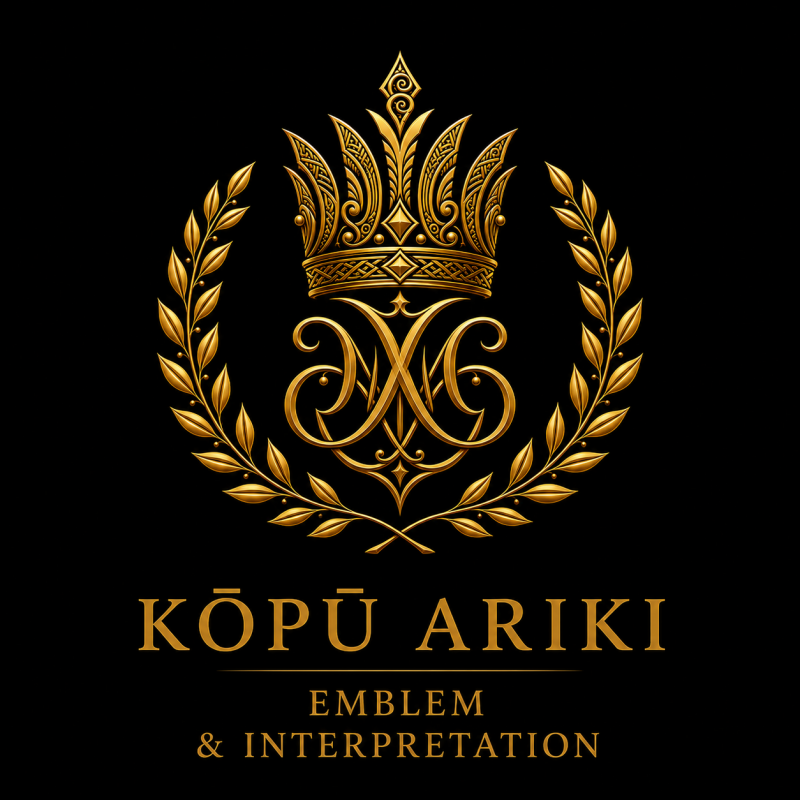
The KŌPŪ ARIKI emblem represents the spiritual, cultural, lived experience, and relational foundations of Te Hui Ō Ngā Whare Ariki — The Gathering Of The Whare Ariki.
The emblem carries multiple layers of meaning, each contributing to the wider purpose of KŌPŪ ARIKI, The Gathering Of The Whare Ariki, and the Te Kōtahitanga Charter.
══════════════════════════
TE PŪMOTOMOTO / RUAWHETŪ (Ariki Headdress)
Te Pūmotomoto represents the Ruawhetū, the fontanel through which every person enters the physical world at birth, through the birth canal.
It symbolises the sacred transition from Te Ao Wairua (Spiritual World), Te Ara Namunamu ki Taiao, into Te Whei Ao, to Te Ao Mārama (Physical World).
Te Pūmotomoto-Ruawhetū represents every participating Whare Ariki, Esteemed Whare, and Paramount Chieftainship Whare. Each Whare has its own sacred genealogy known only by them.
It further symbolises Arikitanga, leadership, guardianship, service, honour, integrity, dignity, responsibility, and the obligations carried by those entrusted with leadership.
Te Pūmotomoto-Ruwhetū acknowledges the mana (supreme authority) and standing of every participating Ariki and Whare Ariki.
The design of Te Pūmotomoto-Ruawhetū contains thirteen feathers.
A single central feather stands at the centre of the headpiece. This is the summit of the 13 dimensions where IO resides. Flanking the central feather are six visible feathers, three on the left side and three on the right side.
Behind the visible feathers are six additional feathers that are concealed from frontal view and cannot be seen when viewing the emblem from the front.
Together, the six visible feathers, the six concealed feathers, and the central feather comprise the thirteen feathers of Te Pūmotomoto - Ruawhetū (Ariki Headdress).
The twelve surrounding feathers represent the Twelve Rangitūhaha (Dimensions) of IO. IO is the Thirteenth feather in the middle.
The central feather represents the Thirteenth Rangitūhaha, the highest point of connection, unity, consciousness, and return. Most IO traditions only speak of 12 realms, dimensions or heavens.
When the 12 heavens were realigned and reopened Te Whare Atua Ō IO Tikitikiōrangi added another dimension to add continuity. Placed into the sequence when the Rangitūhaha was reopened in July 2025 at Marae Vaeāra‘i, Opoa, Ra'iatea.
Together, the twelve surrounding feathers and the central feather comprise the Thirteen Rangitūhaha of IO Te Rangitūātinitini and symbolise the journey of consciousness, Mauri, and lived experience throughout the many dimensions of existence, of which are infinite.
The numbers associated with IO within this symbolism are 1, 0, 10, 12, and 13.
1 represents the singular source.
0 represents Te Korekore, the infinite field of unlimited potential.
10 represents completion and return to unity.
12 represents the Twelve Rangitūhaha, the dimensions through which consciousness, Mauri, experience, and creation move and are expressed.
13 represents the Thirteenth Rangitūhaha, the highest point of connection, unity, consciousness, and return, from which the other dimensions emerge and to which they ultimately return.
Together, these numbers express the movement from source, through potential, into manifestation, throughout the dimensions of existence, and ultimately back into unity.
For this reason, Te Pūmotomoto- Ruawhetū stands not only as a symbol of birth, leadership, and Arikitanga, but also as a representation of the thirteen dimensions through which consciousness, experience, and Mauri move.
══════════════════════════
KŌRŪRŪ (IO MATANGARO)
The design underneath the Ariki headdress is a kōrūrū of IO's unseen face, IO Matangaro. The top circles are the eyes of the face. The bottom bigger circles are the mouth of the face. The downward arch is the protrusion of the tongue.
You will see icons that symbolise the teeth. So to look at it from the front profile its a face. IO's face. In the center of the face arching upwards and holding the Ariki headdress is the symbol of a bird. The Manukura bird. IO's bird.
═════════════════════════
MANUKURA (IO's BIRD)
At the centre of the Kōrūrū stands Manukura.
Manukura represents Te Kōtahitanga Ō Ngā Whare Ariki — The Unification Of The Whare Ariki. You see one central figure, behind it are the many Whare Ariki that constitute Kōpū Ariki - The gathering of the Ariki and their Whare.
Manukura is depicted holding up the Te Pūmotomoto-Ruawhetū (Ariki headdress), symbolising the collective responsibility of all participating Whare Ariki to support, strengthen, uphold, and carry one another.
Manukura represents unity, cooperation, mutual support, collective leadership, and the shared responsibility of safeguarding the aspirations of present and future generations.
It reminds all participating Whare Ariki that true unification is not achieved through authority over others, but through cooperation, respect, reciprocity, and shared responsibility.
═══════════════════════════
PŌHUTUKAWA KŌWHAI - WREATH
The Wreath represents the Pōhutukawa Kōwhai Tree. The tree of Higher Consciousness. (Puhitau).
It symbolises the attainment of higher consciousness through love, service and humility.
It further represents wisdom, awareness, enlightenment, growth, spiritual maturity, achievement, and the continual pursuit of greater understanding.
This is how all the Whare Ariki are united.
The Pōhutukawa Kōwhai reminds all Whare Ariki that leadership is not merely a position but a journey of growth, learning, observation, experience, and increasing consciousness. That an Ariki is firstly a servant to IO and then the people.
The Wreath therefore represents the ongoing pursuit of higher consciousness by both individuals and the collective.
═════════════════════════
MAURI (THE ETERNAL LIFEFORCE)
Mauri is the spiritual life force that moves throughout the entire emblem.
Unlike the other elements of the emblem, Mauri is not confined to a single symbol or position.
It flows through the entire emblem, the Kōrūrū, Manukura, the Pōhutukawa kōwhai Wreath, the interwoven relationships, and all participating Whare Ariki.
Mauri is the living presence that gives movement, vitality, purpose, and life to the whole.
It connects IO, Te Kōtahitanga Ō Ngā Whare Ariki, the participating Whare Ariki, and the pursuit of higher consciousness.
Mauri is experienced through living, observing, participating, relating, serving, learning, and growing. It is not merely understood intellectually but known through direct lived experience.
Without Mauri, the emblem is merely a collection of symbols.
With Mauri, the emblem becomes living, relational, and active.
Mauri therefore represents the spiritual life force of IO that flows through all things and unites the various elements of the emblem into a single living expression of Te Kōtahitanga Ō Ngā Whare Ariki. (Unity).
═════════════════════════
WHANAUNGATANGA RELATIONSHIPS
The intertwined design at the centre of the emblem symbolises interconnectedness.
It represents whakapapa connections, shared histories, enduring relationships, cooperation, mutual support, and the weaving together of diverse traditions. It reveals we accept all Ariki and all Whare. That according to our Te Kōtahitanga Charter we will never diminish the mauri of any person, Ariki or their Whare.
The interwoven form reflects Te Takapau Wharanui. The woven mat, the understanding that many Whare, many traditions, and many pathways may coexist while contributing to a common purpose.
It acknowledges that unity does not require uniformity and that diversity may exist within a shared commitment to mutual respect and good faith.
═══════════════════════════
HANGA - SYMMETRY
The balanced symmetry of the emblem represents equality.
The left and right sides mirror one another, reflecting the principle that every participating Whare Ariki enters KŌPŪ ARIKI as an equal.
This directly reflects Article I of the Te Kōtahitanga Charter, which recognises that no Whare Ariki stands above another and that all possess equal standing within Te Whakatau Aroha - the Alliance.
═══════════════════════════
THE GOLD
Gold symbolises honour, wisdom, knowledge, excellence, achievement, prosperity, permanence, and legacy.
Within KŌPŪ ARIKI it represents the value placed upon whakapapa, sacred knowledge, leadership, lived experience, cultural continuity, and future generations.
Gold symbolises the light of knowledge emerging into the world through service, leadership, and experience.
═════════════════════════
THE BLACK BACKGROUND
Black symbolises, Āio Te Korekore: Eternal Peace throughout Eternity, dignity, strength, sacredness, permanence, formality, and timelessness.
It provides the lived experience foundation upon which the gold elements emerge.
The contrast between black and gold symbolises knowledge, wisdom, leadership, and consciousness emerging from the deeper mysteries of existence.
═══════════════════════════
OVERALL MEANING
The Te Pūmotomoto represents Ruawhetū (Ariki headdress), Arikitanga, and the collective body of participating Whare Ariki.
The Kōrūrū represents IO, from whom all Whare Ariki emerge.
Manukura represents Te Kōtahitanga Ō Ngā Whare Ariki — The Unification Of The Whare Ariki.
The Pōhutukawa Kōwhai Wreath represents higher consciousness, wisdom, growth, enlightenment, achievement, and spiritual maturity, love and service with humility.
Mauri represents the spiritual life force flowing through all elements of the emblem.
The Interwoven Design, Te Takapau Wharanui represents whakapapa, relationship, cooperation, and interconnectedness.
The Symmetry represents equality.
The Gold represents honour, knowledge, wisdom, excellence, and legacy.
The Black represents Āio Te Korekore - Eternal Peace throughout Eternity, dignity, sacredness, permanence, timelessness, and lived experience.
Together, the elements of the emblem express a pathway that is not founded solely upon belief, ceremony, or theory, but upon lived experience, direct participation, relationship, observation, responsibility, and growth.
Together, the emblem represents:
"TE KŌTAHITANGA Ō NGĀ WHARE ARIKI — THE UNIFICATION OF THE WHARE ARIKI — THROUGH SHARED ORIGIN, COLLECTIVE RESPONSIBILITY, EQUALITY, HIGHER CONSCIOUSNESS, MUTUAL SUPPORT, GOOD FAITH, LIVED EXPERIENCE, AND THE FLOW OF MAURI THROUGH ALL THINGS."
It stands as the visual expression of the Te Kōtahitanga Charter and the enduring aspirations of Te Kōtahitanga Ō Ngā Whare Ariki — The Unification Of The Whare Ariki.
EMBLEM WITH THE NAME
The KŌPŪ ARIKI emblem displayed together with the words "KŌPŪ ARIKI" serves as the official public identity of Te Hui Ō Ngā Whare Ariki — The Gathering Of The Whare Ariki.
This version is intended for invitations, websites, correspondence, programmes, signage, presentations, publications, social media platforms, and other public communications where immediate identification is important.
The wording assists people who may be unfamiliar with the emblem by clearly identifying the gathering, kaupapa, and purpose it represents.
In this form, the emblem and name work together as the official public-facing identity of KŌPŪ ARIKI.
═════════════════════════
EMBLEM WITHOUT THE NAME
The KŌPŪ ARIKI emblem displayed without wording serves as the enduring tohu of Te Kōtahitanga Ō Ngā Whare Ariki.
This version is intended for flags, regalia, seals, certificates, lapel pins, vehicle decals, watermarks, carvings, artworks, and other symbolic applications where the emblem is permitted to stand on its own.
As recognition grows over time, the emblem itself may become immediately identifiable without the need for accompanying words.
In this form, the emblem stands as a visual expression of Te Kōtahitanga Ō Ngā Whare Ariki — The Unification Of The Whare Ariki — and the enduring relationships, responsibilities, aspirations, and shared foundations of the participating Whare Ariki.
The emblem without words represents the tohu.
The emblem with the words "KŌPŪ ARIKI" represents the gathering.
Together, both forms serve the same kaupapa while fulfilling different functions. This event is invite only.
This emblem was designed and created by Kupe Nuku IO-Ariki from Te Whare Atua Ō IO Tikitikiōrangi and Te Whare Ō Kupe-Ariki for this years KŌPŪ ARIKI 2026.